The Empress’s order to break the telescopes
The Blazing WorldThe Empress’s order to break the telescopes is the turning point in a dispute over whether artificial instruments can make celestial knowledge more reliable. After the Bird-men’s observations and the Bear-men’s experiments produce competing accounts rather than a settled truth, the Empress condemns the glasses as deceptive and commands their destruction. Yet she reverses course when the Bear-men defend their instruments and their arguments: they may keep the telescopes, provided their quarrels remain inside their schools and do not disturb the state.
The inquiry that provokes the order
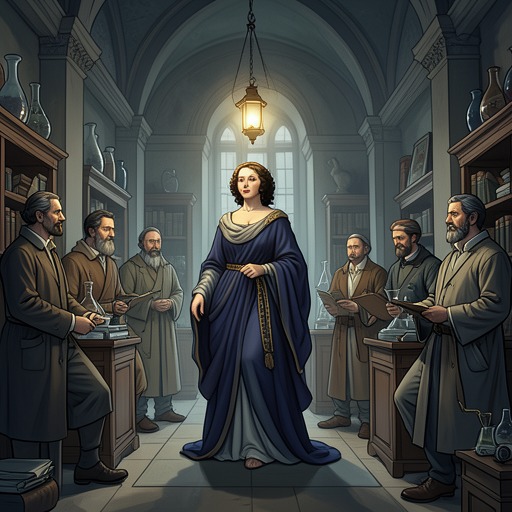
The order grows out of the Empress’s effort to give the newly founded learned societies definite work. Once she judges that the societies have made progress, she convenes the Bird-men and asks for a faithful account of the Sun and Moon. Their earlier report describes the Sun as a vast, solid, yellowish stone and the Moon as a self-luminous body whose center is eccentric in relation to the world. Even the Moon’s spots are explained as flaws or stains in its stony substance. On the Sun’s heat, however, the observers disagree: some consider the Sun fiery in itself, while others argue that its heat is produced by reflected light. The inquiry begins, then, with a report that already contains rival explanations rather than a single authoritative account.
The Empress subsequently asks the Bird-men about thunder and lightning. One account attributes them to an encounter between cold and heat: an exhalation ignites in clouds and produces lightning, while the clouds’ ruptures produce thunder. Others propose that thunder is a sudden blaze in the air that does not always require a cloud. The Empress prefers the first explanation because she cannot understand what the other observers mean by “Blaz,” a term they themselves cannot explain. To investigate celestial phenomena more exactly and avoid prolonged disputes, she directs the Bear-men, who serve as her Experimental Philosophers, to observe through Telescopes.
Reports without agreement
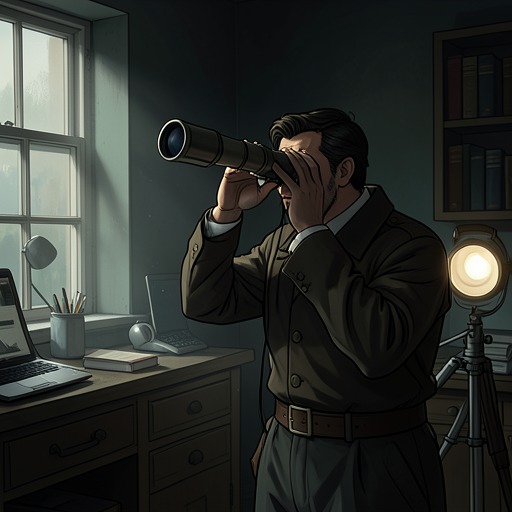
The Telescopes do not bring the investigators to agreement. Some observers say the Sun stands still while the Earth moves around it; others think both bodies move, and still others hold that the Earth stands still and the Sun moves. Their reports also differ over the number and size of stars, the discovery of previously unseen stars, and the Moon’s landscape. Some call the Moon another world, with its spots as hills and valleys; others interpret the spots as land and its smooth, glossy parts as sea. The instrument gives the observers more to report, but no common account of what they see.
The Empress sends the Bear-men to the end of the pole joined to the world from which she came, asking them to look for stars there. On their return they report three Blazing-Stars appearing one after another in a short time: two bright, one dim. Their interpretation divides again. Some say it was one star appearing at three times and in three places; others insist that there were three stars. The latter argue that a single star could not appear in different, even opposite, positions in so little time without visible motion, and that one star would not vary in brightness in the way described. Thus the telescopes have not resolved the question of what appeared: their report itself becomes the subject of another dispute.
The command and the Bear-men’s defense
Growing angry at the conflicting reports, the Empress judges that the “Glasses” are false informers, deceiving rather than correcting the senses. She orders the Bear-men to break them and tells the Bird-men to trust their natural eyes, examining celestial objects through the motions of sense and reason. The Bear-men protest that the disagreement is not caused by faulty glasses: their optical senses do not move alike, and their rational judgments are not always regular. The Empress rejects this defense. If the instruments truly informed, she argues, they would correct irregular sense and reason; nature has made those faculties more regular than art has made the glasses. In her view, direct perception is a better guide to the progressive motions of celestial bodies.
The Bear-men kneel and ask that the instruments be spared. They admit that they take more delight in artificial delusions than in natural truths. Without falsehood, they contend, there would be no disputes to pursue, no arguments to confute, and no opportunity for one person to be thought wiser than another. Their defense shifts the question from whether the telescopes have settled astronomy to what the society values in them: the instruments sustain work for the senses and subjects for argument, even when they fail to produce consensus.
The Empress ultimately consents, but only on a political condition. The Bear-men may retain their Telescopes if their disputes and quarrels stay within their Schools and do not produce factions or disturbances in the state or government. The order to break them is therefore withdrawn, but the Empress does not accept the Bear-men’s claims about the instruments as proof that their method is reliable. Instead, she preserves their practice under limits, separating the pleasure of scholarly controversy from the political consequences she fears.
From telescopes to microscopes
After thanking the Empress, the Bear-men offer other optical instruments they believe will give her greater satisfaction. They show her Microscopes, which enlarge small bodies; their examples include a louse magnified to the size of an elephant and a mite to the size of a whale. The Empress questions their claim that the numerous tiny hemispheres on a drone-fly’s head are each eyes. The Bear-men answer that the structures have transparent corneas and fluid resembling the humors of an eye, and insist that Microscopes correct the senses rather than deceive them. Their confidence contrasts with the Empress’s distrust of the Telescopes, but her doubts about what magnification proves remain.
The limits of this confidence become visible when a Whale cannot be fitted into the magnifying capacity of their largest Microscope. The Empress asks whether glasses can instead make large objects appear smaller. The Bear-men produce instruments through which a Whale appears no larger than a Sprat or even a Vinegar-Eele; ordinary versions make an Elephant look like a Flea, a Camel like a Louse, and an Ostrich like a Mite. Yet even their ingenuity cannot make instruments that reveal a Vacuum in all its dimensions, or Immaterial substances, Non-beings, and beings between something and nothing. The telescopes’ failure to settle celestial disagreement thus belongs to a broader limit: instruments alter the scale and appearance of what observers inspect, but cannot disclose every kind of reality.
Significance
The episode does not simply replace trust in instruments with trust in unaided sight. The Empress initially treats the telescopes’ conflicting results as evidence that the glasses deceive, while the Bear-men locate the problem in differences among observers’ senses and reasoning. Their appeal for the instruments’ survival is not a demonstration that they can settle the disputed claims; it openly acknowledges the pleasure of continuing to argue. The outcome preserves both the ruler’s suspicion and the scholars’ attachment to experimental inquiry, but makes the latter subordinate to political order.
That compromise connects the episode to the Empress’s wider management of knowledge. She has established learned societies and assigned different peoples specialized intellectual roles; here she does not abolish the Bear-men’s work when it disappoints her, but draws a boundary around its consequences. Disagreement may persist as a school activity, not as a source of state faction. The telescopes consequently function both as instruments of observation and as objects around which authority, sensory judgment, and scholarly ambition collide. The command to break them exposes the gap between seeing more and agreeing about what has been seen; its reversal leaves that gap open, while containing its political reach.